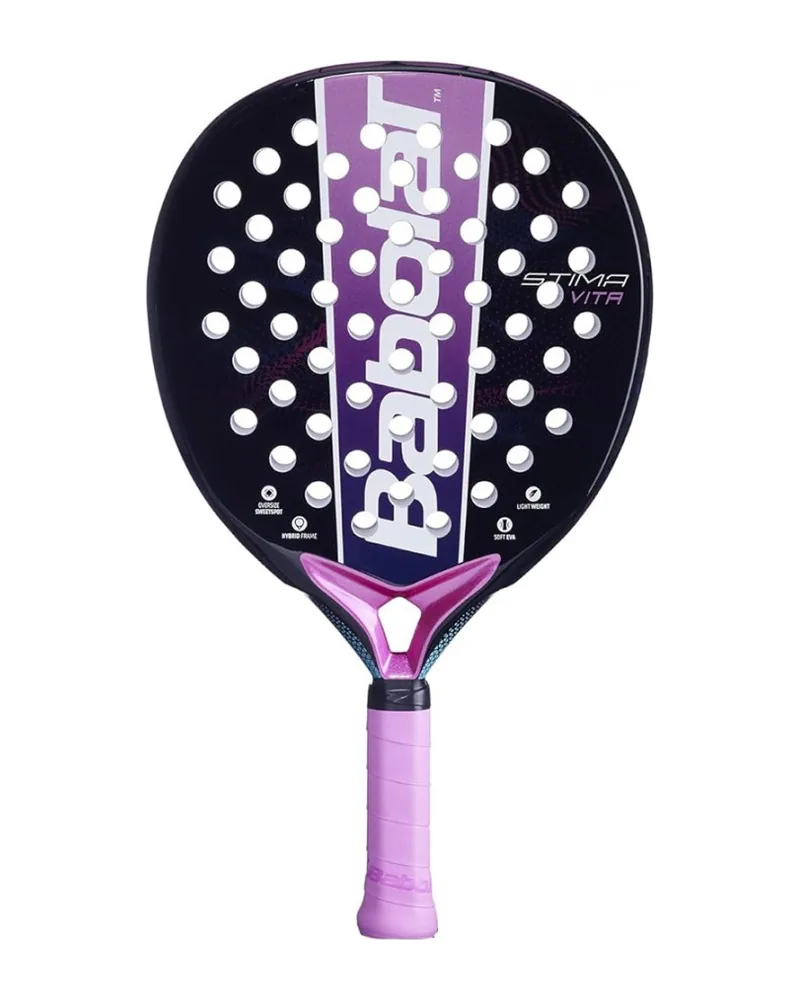
Babolat Stima Vita (2025)
Light round racket with low balance, so it is quick to move and forgiving off-centre
Does it fit you?
Answer five questions about how you play. Each answer adds a line to this racket's checklist, so you see where it fits you and where it does not.
Buy it
You cannot buy it here yet
No merchant we can reach ships this racket to your country. It is still a racket that might fit you.
A racket we can deliver to youPlaying characteristics
On one 1–10 scale
Each bar describes this racket on its own. None is a score of how good it is, and nothing here adds them up. A publisher's figure is theirs — we did not measure any of these.
Power
No verified value yet
How much pace the racket can put on the ball from a full, committed swing. No verified value on this shared scale yet, so we show none.
Control
No verified value yet
How predictably the ball goes where you aimed it. No verified value on this shared scale yet, so we show none.
Hardness
No verified value yet
How firm the whole finished racket feels at impact — not only its core — so a firmer feel sends more of the shock into your arm. No verified value on this shared scale yet, so we show none.
Agility
No verified value yet
How easily the racket starts, stops and changes direction in your hand, so quick exchanges take less effort. No verified value on this shared scale yet, so we show none.
Ball output
No verified value yet
How much pace the ball leaves with from an easy, low-effort swing, so less of the depth has to come from your arm. No verified value on this shared scale yet, so we show none.
Sweet spot
No verified value yet
How large the forgiving area of the face is, so a hit that misses the centre still plays well. No verified value on this shared scale yet, so we show none.
Roughness
No verified value yet
How much texture the face's surface has, which is what lets a brushed shot grip the ball. No verified value on this shared scale yet, so we show none.
What its build means for you
- Shape
- — The face stays wide around its centre, giving central contact more face around it.
- Balance
- — The weight sits toward the grip, so the racket turns faster in your hand and gives less free power.
- Weight
- — A heavier racket is steadier and carries more of its own power but asks more of your arm; a lighter one is quicker to swing and gives less free power.
- For a level
- — The least experienced player the catalogue judges it suits — it is not a limit on anyone above.
- Core
- — A softer core flexes and holds the ball a moment longer, so less shock reaches your elbow and a swing gets less free power.
- Face
- — A fibreglass face flexes more, trading some power for control and comfort.
- Surface
- — No added texture, so any spin comes from the swing alone.
- Sweet spot
- — A wide forgiving area, so a hit that misses the centre still plays well.
- Vibration absorption
- — Less of the shock of each impact reaches your arm.
- Arm-friendly
- — The catalogue marks it as gentle on a sore elbow or shoulder.
See what shape, balance and weight mean before you choose.
How to choose a padel racket